| Make |
Morris |
| Model |
Leader |
| Type |
Motive unit |
| Body Builder |
Brockhouse chassis - Trailer No. 1 |
| Use |
Mobile Post Office |
| Registration Number |
GPO 1 and GPO 2 (used many times) |
| Fleet Number |
10883 (GPO 1) and 13009 (GPO 2) |
| Date of picture |
1937 |
The trailer was made by Brockhouse. The trailer chassis was a
Brockhouse "Kwikfiks" articulated attachment.
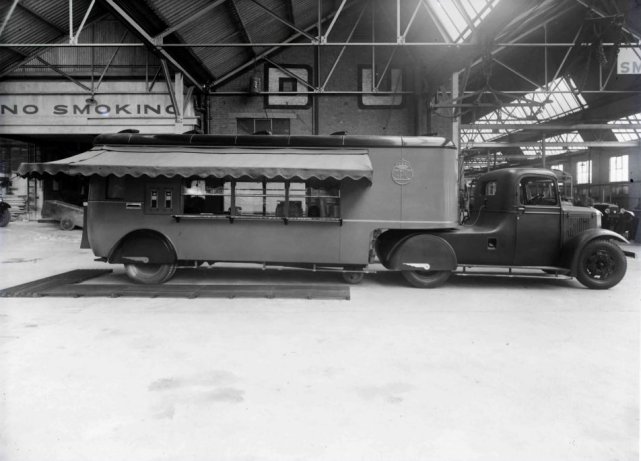
An extract from
POEEJ Volume 29, Part 3 - Dated October 1936
A Mobile Post Office
By W. G. DUNK and C. F. MILLS
A recent innovation in Post Office services is a “Post Office on
Wheels”. It is designed to afford essential post office facilities at
important open-air functions, such as exhibitions and sports meetings.
Introduction
The provision of telegraph, telephone and postal facilities at what are
officially termed “special events” presents very interesting problems.
Generally, for race meetings, etc., which occur at stated intervals,
buildings are permanently wired for the telecommunication services, the
apparatus being sent to the site before the meeting and recovered directly
afterwards. The smaller event is, however, more difficult to cater for,
especially in regard to telephone facilities, as telephone call offices
which give reasonable sound qualities are not easily erected and dismantled.
To meet these conditions it was decided to build a motor vehicle which would
provide facilities for these services and thus reduce preliminary work to a
minimum.
As a result of discussions between representatives of the Headquarters
Departments concerned it was decided that the under mentioned facilities
should be provided in a motor vehicle:-
-
Telegraph - Acceptance of telegrams from the public
and receipt of telegrams at the vehicle.
-
Telephone - Trunk and local telephone service from
two telephone cabinets built in the vehicle.
-
Postal - Sale of stamps, acceptance of letters and
parcels and registration of letters and packets.
Type of Vehicle
After the services were decided consideration was given to the type of
vehicle most suitable for the work, bearing in mind the many governing
factors, e.g., limitation in size by the Road Traffic Act to overall length
of 33 ft. and overall width of 7 ft. 6 in.; ability to manoeuvre; economy in
capital cost and in maintenance costs; maximum floor space; low floor
position for the staff and the public telephone cabinets; convenient height
for the counter and windows used by the public. With these factors in mind,
it was decided that the most suitable vehicle would be the articulated type,
i.e., with the tractive unit separate from the body portion, which would
allow a vehicle to be produced of maximum length of 33 ft. This type of
vehicle is easier to manoeuvre than a rigid vehicle of the size required, a
factor which is important in view of the certainty that the vehicle will be
used at functions held in fields approached by narrow and twisting lanes and
narrow gateways. A saving in cost was also effected, a rigid vehicle costing
appreciably more.
The body of the vehicle, which is referred to as the trailer, had to house
two telephone call offices and provide accommodation for three counter
clerks with facilities to conduct telegraph and postal business, and
provision for these had to be made in a body of maximum over-all horizontal
dimensions of 22 ft. long by 7 ft. 6 ins. wide. The lay-out adopted is shown
below.
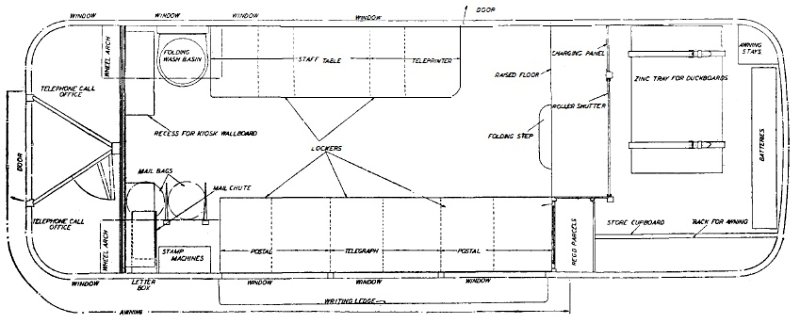
Trailer layout
The window height was important as service to the public
for postal and telegraph business had, of course, to be at a convenient
height. A Brock-house drop frame trailer was accordingly selected which
enabled windows to be fitted 3 ft. 11 ins. from the ground. A floor height
of 1 ft. 5 ins. was also obtained. The trailer is marketed by Messrs. J.
Brockhouse & Co., Ltd., and is fitted with that firm’s patent “Kwikfiks ”
attachment. This attachment allows the tractor, which is equipped with the
other half of the coupling, to be linked up to the trailer by simply backing
the former to the latter until the king-pin on the trailer engages with a
hooked coupling on the tractor. The connexion is automatic and at the same
time the brake on the trailer is coupled to a lever on the tractor. The
“Post Office” body is built upon the trailer and its shape was designed on
lines which are considered to be the most attractive and pleasing consistent
with utility. It is partitioned into three compartments, the rearmost
portion housing the telephone cabinets, the centre portion the office proper
and the front what may be termed a store room. The three postal and
telegraph counters are situated in the vehicle at the offside and
accommodation for the teleprinter is provided on a counter at the nearside.
The two telephone cabinets are reached by a folding step, single tread,
between the ground and the platform forming the floor of the cabinets. In
order to facilitate entry and egress and to allow as much interior room as
possible, access to each call office is by a two-sectioned folding door, set
at an angle and hinged to a pillar fitted centrally on the partition which
forms the backs of the cabinets. When the vehicle is not in use a rear door
encloses the platform which gives the vehicle an orthodox rear view. This
door, when the vehicle is “on duty,” is fixed open with a door adjuster at
an angle of 90° and the inside of the door thus exposed is fitted with a
grip handle to assist entry of the public to the call offices. A similar
handle is fitted just inside the shut pillar. The following notice is
inscribed in Roman Trojan type engraved on black with cream lettering on the
inside face of the door “Public Telephones - Local and Trunk Services.”
The usual type of folding door is fitted to the cabinets
and the construction generally follows that used for cabinets in public
offices, thus allowing as large a measure of sound-proofing as possible.
The Call Offices
The call office layout is that used in the new Jubilee kiosk, one minor
modification having to be made to the offside call office to allow for the
passage of the letter chute. This was effected by altering the directory
pigeon-hole and in no way detracts from the appearance of the layout or
lessens its utility.
To provide connexion with any type of exchange, Magneto, CBS Nos. 1, 2 and
3, CB, and automatic systems, including unit automatic exchanges,
necessitated the design of a special circuit and to avoid change of
instruments in the vehicle or provision of special plant at exchanges,
postpayment coin boxes were necessary. This arrangement has certain traffic
disadvantages as postpayment working in prepayment areas will sometimes be
occasioned, but the Traffic Branch, viewing all considerations, did not
anticipate any considerable difficulty in this direction as they will have
due notice of the special event and sufficient time to prepare suitable
instructions for the guidance of the operating staff.
In the circumstances in which the vehicle will be used it may be assumed
that a considerable number of persons wishing to use the call office will
require connexion to tow ns not in the immediate vicinity of the event, and
to prepare comprehensive lists of charges for such calls and provide
accommodation for them, would cause difficulty. Skeleton lists will
therefore be prepared.
A special call office circuit was designed using a Telephone No. 196 LB
lilted with a Dial ,Automatic No. SS 11 FA, three dry cells and a six point
two-position switch for changing from loop to earth ringing. The latter
connexion is required in CBS No. 1 areas only. In CB and CBS areas the
operators' attention will be called by lifting the receiver and for magneto
areas a generator is provided. In non-automatic areas the dial of the
Telephone No. 196 LB is covered by a cap. The generator is housed in the
coin-collecting box and when not in use the hole for the handle is covered
by a screwed cap, the handle being stored in the battery compartment of
the parcel receptacle. In automatic areas the attention of the operator is
obtained by dialling 0 or the local two digit code.
The call offices are connected to Protectors HC and F 2/2 mounted on a board
immediately below the roof of the vehicle at the nearside of the trailer.
From this board connexion to the telephone network will be made by Cable IR
Aerial 8 pair/20, the cable passing through the side of the trailer. The
entry is so arranged that rain will not enter. A third telephone circuit is
provided for telephoning telegrams when the teleprinter is not in use or is
temporarily out of service. This telephone connexion is paralleled to the
public counter and can thus be used for service messages when required. It
was not considered necessary to make special arrangements for direct
connexion to underground cables.
Telegraph and Postal Equipment
Telegraph service will normally be provided by Teleprinter No. 3A. Unit
Auxiliary Apparatus No. 72 is used with the teleprinter and provides
facilities for simplex, duplex and YQ workings. A pair of leads from the
teleprinter position is brought to a Protector HC and F 2/2 on the terminal
board on which are also mounted the telephone protectors and the line
connexion is made here.
From the charging panel a lead is connected to the teleprinter position
giving 110 volts. This is required for the motor drive. Across the 110-volt
leads a potentiometer consisting of 4,000 + 4,000 ohms is connected, thus
giving 55 + 55 volts positive and negative potentials from either side of
the centre tap, and is used to provide the line and local currents.
Adjacent to the public counter are two stamp-selling machines (1/2d. and
Id.) and a letter chute. When the vehicle is not in use the stamp-selling
machine mechanisms are removed and a shutter covered with aluminium sheet is
inserted in the aperture and held in position by two Bloxwich spigot budget
locks. A spring-loaded hinged louvre type of cover is fixed over the letter
chute aperture and a temporary shutter is placed over this cover when the
vehicle is “off duty.” One end of the chute is attached to the posting box
aperture and the chute continues to the mouth of a mail bag so that handling
of postal packets is reduced to a minimum. When the vehicle is in use two
mail bags are utilized; they are held on detachable hook arms similar to but
smaller than those used in sorting offices. As previously stated one of
these bags is under the letter chute and the other is for parcels.
As far as possible, having regard to the space limitations of the trailer,
the drawer and shelf accommodation normally provided in Post Offices has
been installed. This is an important feature as the postal and telegraph
personnel will be drawn from the local stall', and as rush times may be
expected, it was essential that the personnel should carry out their duties
under conditions of accommodation as near normal as possible.
Stamps, cash, etc., will not be kept in the trailer when the staff is not on
duty. The stock of stamps, cash, etc., will be handed over to the local
postmaster for safe custody at the end of the day’s business. It is the
usual practice to keep this stock in metal deed boxes and racks at the backs
of the three knee-holes under the service counters have been provided to
accommodate them during “office hours.” Separate locked cupboards are
provided for registered letters and parcels. These cupboards have framed
doors with expanded metal fronts so that when the cupboards are being
cleared, packages are not overlooked.
For the convenience of the public, a sloped writing ledge, in three pieces,
but forming a continuous shell, is fitted under the three public windows.
The ledge is removable and is mounted on four detachable mild steel brackets
which slide into brass brackets screwed to the side of the vehicle.
Staff amenities have not been overlooked. A wash-basin of the ship cabin
tip-up type, purchased from Messrs. Beresford & Sons, Ltd., is installed,
water being drawn from a tank of six gallons’ capacity fitted near the roof
and filled from inside the vehicle. An electric kettle is included and this
is filled from a tap fitted in the feed pipe connecting the storage tank to
the wash basin tap. A table is also provided with cupboard space for staff
use. On the front of the partition which forms the back of the call offices
is a luggage rack, similar to those fitted to modern motor coaches.
Seats for the staff are of the type used by phonogram operators, generally
referred to as the “Tan-Sad" type. These chairs have been specially
upholstered and finished to match the general internal colour scheme of the
vehicle.
The public counters, teleprinter and staff table tops are constructed of
plywood, covered with black Bakelite and are edged with stainless steel.
These tops were manufactured by Messrs. Tucker Armoured Plywood Co., Ltd.
Power Supplies
Provision of electrical energy for the teleprinter and lighting of the
vehicle presented a certain amount of difficulty.
At first it was considered that a petrol or diesel engine-generator set,
housed in the fore part of the vehicle, would be a suitable means, but
examination of various charging sets revealed the fact that such a scheme
was undesirable owing to lack of space, noise and vibration. It was
ultimately decided to mount the generator on the tractor and to drive it
from the engine of that unit by means of a power take-off from the gear-box,
which is controlled by a lever in the floor of the cab.
Although normally the generator will be used while the vehicle is
stationary, it will be possible to charge the batteries while the vehicle is
travelling.
The generator, a light weight, enclosed, ventilated, shunt compound machine
producing 15 amperes at 98/150 volts, runs at 1,500 r.p.m. It is housed in
the driver’s cab on supports underneath the passenger’s seat and is easily
accessible.
The generator supplies current to charge two batteries of 54 cells at a
normal charging rate of 3 amperes. The batteries were supplied by Messrs.
The D. P. Battery Co., Ltd., being their MEZ traction type. Sealed ebonite
containers are used and the cells are assembled in three hardwood crates
each containing 18 cells.
The batteries are carried in the fore part of the vehicle on light section
steel racks (Fig.5). The two under trays are arranged to draw forward to
allow for taking hydrometer tests and topping the cells when necessary. In
order to facilitate this work the battery trays rest on rollers and when
attention to batteries is required, detachable bracket arms affixed to the
rack at the level of the bottom of the tray provide a support for the tray
and battery.
The charging panel allows for the charging of the batteries separately or in
parallel and also for the supply of current direct from the generator to the
lighting circuit should this be necessary. As the space in the vehicle is
limited iron-clad switch gear was provided. The charging panel was supplied
by Messrs. The Power Equipment Co., Ltd.
Connexion between the generator and the charging panel is effected by a
multi-core tough rubber type cable. Included in this cable is a pair of
wires for the rear light of the trailer, current for which is supplied by
the ordinary lighting dynamo on the tractor. The cable connectors are of the
watertight plug and socket type.
For the guidance of the engineering staff, the necessary instructions,
circuit diagrams, etc., have been bound into folders in duplicate. The
instructions include circuit diagrams of the call-office circuit, charging
panel connexions and instructions regarding the removal and packing of the
stamp-selling machines. A set of call office instruction cards proper to
each area will also be carried on the vehicle.
Constructional Details of Trailer Body
The framework of the body consists of 24 vertical pillars attached direct to
the. trailer chassis, each point of attachment being reinforced with a mild
steel bracket. There are five horizontal body rails which are halved into
the vertical pillars and reinforced where necessary with mild steel plates.
At the rear these rails are equally spaced, but at the sides they are
arranged to suit the service windows, the bottoms of which are 47 ins. from
the ground. At the offside an additional rail was inserted 5 ins. below the
cant rail to provide a cavity for the awning rail. Furthermore, on this side
of the vehicle special framing was required for the stamp machines and
letter box aperture. Also the nearside framing was reinforced to hold the
auxiliary unit for the teleprinter. Twelve curved roof rails, five
longitudinal and seven transverse, complete the main framing and these are
checked into the cant rail.
In addition to the skeleton, framing for two partitions was necessary. The
rear partition, which is fixed, isolates the telephone cabinets and the
other divides the front portion of the body from the main compartment. A
roller shutter has been provided in the latter.
Each of the outside doors is framed by two vertical pillars and five
horizontal rails, the latter being mortised and tenoned into the former. All
the framework is constructed of English ash.
The flooring consists of tongued and grooved deal boards 1 in. thick placed
longitudinally. The normal construction of motor van bodies provides for
crossbars, but the inclusion of such members in the body under review would
have negatived to a certain extent the advantage of the low frame height. It
was accordingly decided to dispense with them and bolt the boards direct to
the trailer frame.
Panelling
The vehicle is panelled externally with aluminium sheet 16 s.w.g., and the
joints of the panels are covered with 1 in. x 3/16 in. half-round aluminium
moulding. Panelling of the inside of the body is effected with birch plywood
3/16 in. thick on all flat surfaces and with aluminium sheet 16 s.w.g. on
the curved surfaces and the under side of the roof. InsulBoard, marketed by
Messrs. G. D. Peters & Co., a proprietary material, has been provided in the
walls of the telephone cabinets to obtain maximum sound proofing.
Windows
The design of the three windows over the service counters on the off-side of
the body presented some difficulty. Motor coach windows on the market are
normally of the “half drop” or “side-sliding” types. The kind of windows
required for the vehicle was a “half-lift ” pattern, a type which did not
appear to be marketed. It was therefore necessary to design and manufacture
special windows. They are 36 ins. wide x 30 ins. high and are made of
1/4in. Triplex toughened glass. Behind each there is an inside pane 36 ins.
wide x 12 ins. high, also of Triplex toughened glass, with a pigeon-hole cut
from the bottom and in the centre. It is recognized that pigeon-holes have
certain disadvantages but it was decided that they were essential in order
to minimize draught through the windows and so cause as little inconvenience
as possible by papers, etc., on the counters being disturbed. The outer
glass extends over the full width and height of the window frame and lifts
sufficiently to expose the pigeon-hole in the smaller pane. The small panes
of glass in the two forward windows are fixed, but that in the rearmost
window has been made to lift so that parcels may be passed through the
window to the counter clerk. In order to promote easy operation of the
windows they are fitted with a balance mechanism on the spring loaded roller
principle. On the nearside there are four windows, two large and two small.
The larger ones are fixed at the bottom but are provided with hinged louvre
ventilators at the top. The two smaller ones are in the nearside telephone
cabinet and over the wash basin respectively and are fitted with opaque
glass.
Awnings
Protection for the public from sun and rain is afforded by an awning over
the service windows, which extends from a point 18" forward of the foremost
service window to the nearside of the rear door and is in four pieces, each
being 4' deep. Green “Willesden” canvas has been utilized for the awning and
a scalloped and bound frill enhances its appearance. It is supported by
eight removable stays, each 3' 6" long which are made of steel tubing, their
free ends being linked together with steel tubes to which the bottom of the
awning is attached. The awning supports are so designed that the awning can
withstand the strongest wind. The recess or cavity which houses the awning
rail is provided with a wooden cover which is placed into position when the
awning is not in use.
Duckboards
Six heavy duckboards 4' x 2' 6" are available for use on wet or muddy
ground. They are constructed of oak, treated with external solignum and are
sufficient to cover the ground in front of the service windows and that
round the offside rear corner to the door leading to the telephone cabinets.
Tractor
The tractive unit is a standard Morris Commercial 3-ton “Leader Tractor”
chassis with a four cylinder engine rated at 24.8 h.p. It is fitted with a
specially designed cab to conform as far as possible with the lines of the
trailer body but departure from the ideal was necessary owing to the
appreciable clearance required for the rear and sides of the tractor when
driving the vehicle along roads with acute bends. Such roads will frequently
be met in the districts where the vehicle is used.
Decoration scheme and Ventilation
The exterior colour of the trailer and tractor is generally “Post Office
Red,” British Standard colour No. 38 and cellulose finished. The roof of
both units and the mudguards and cover plates are black. The “flying wing”
ornaments on the cover plates of the rear wings are red. With a view to
improving the attractiveness of the general appearance of the outside, the
waist moulding on the trailer body is finished a golden colour. Gold leaf
was considered for this moulding but for reasons of cost and durability it
was decided to utilize anodized aluminium moulding for this purpose, as
metal so treated is more durable and less prone to disfigurement than a gold
finish. The “G.P.O.” monogram, also in golden anodized aluminium, appears on
each side of the trailer body, as well as on the rear door.
The mudguards or wings were designed lo be in keeping with the general lines
of the body. The rear ones on both the trailer and tractor follow a similar
streamlined contour and are each fitted with a detachable cover plate with a
“flying wing” ornament placed in a suitable position, It was essential that
detachable cover plates be provided in order to secure accessibility to the
wheels and tyres for replacement and repair purposes. The front wings of the
tractor are the orthodox curved type. It was not possible to lit cover
plates on these as it was necessary to allow for the turning lock of the
front wheels.
The interior colour scheme is black and grey with most fittings chromium
finished. This scheme creates an impression of spaciousness (Fig. 6). The
roof and as much of the remainder of the interior as practicable is lined
with grey Rexine, which is washable, uncovered parts being painted
dove-grey. Dreadnought-grey linoleum covers the floor.
Ten “Ashanco" ventilators are provided in the roof, one over each telephone
cabinet, six equally spaced over the main body compartment and the other two
over the forward portion. Each ventilator is fitted with a “hit-and-miss”
grid so that air currents may be controlled when necessary. In addition the
pigeon holes in the service windows and the open portion of the two large
nearside windows afford adequate circulation of the air.
In order lo minimize the heat inside the vehicle during hot weather the roof
is lined with Alfol marketed by Messrs. Alfol Insulations, Ltd., a
proprietary heat-resisting and insulating material. This is inserted between
the outer covering and the inside lining of the roof.
For publicity purposes and in order to provide adequate and efficient
illumination for the staff and to harmonize with the general decorative
scheme special attention was paid lo the type and position of the internal
electric light fittings. In addition to eight “D” section roof lights in the
main body similar fittings are affixed to the body pillars over the service
and staff counters. The latter were considered necessary as the roof lights
might cast shadows which would hamper the counter clerks in their duties.
Furthermore, each counter is provided with a plug point for a table lamp,
which might possibly be required, e.g., by the teleprinter operator.
Locks
To prevent the entry of unauthorized persons into the vehicle each door has
been equipped, in addition to a slam lock, with two locks, one a Yale type
and the other a Bloxwich spigot budget type. Similar type locks are fitted
to the cab doors.
The internal locks are Yale pattern and a separate key combination is
provided for each counter position. A padlock is provided to secure the
roller shutter of the storage compartment.
Prevention of Fire
Four Pyrene chromium plated fire extinguishers have been provided, three in
the trailer and one in the tractor.
Miscellaneous Accessories
The front or store compartment of the trailer has a higher floor level than
that in the main body and is reached by a folding step. In addition to
holding the batteries it is equipped with racks for the awning, awning
stays, duckboards, writing ledges, tools, spare parts and accessories for
the use of the staff responsible for the maintenance of the vehicle. The
accessories include a broom, mop, cleaning rags, polishing cloths, a step
ladder, a can for filling the water tank, a pail for emptying the waste tank
and a plank for placing beneath the parking wheels of the trailer to prevent
them from sinking into soft ground.
Registration
For publicity reasons the Ministry of Transport was approached with the
request that the registration index letters GPO should be allotted to the
General Post Office for use on special publicity vehicles such as the Mobile
Post Office. The Ministry agreed and this index mark has been allotted to
the London County Council for the exclusive use of the Post Office. The
registration number of the Mobile Post Office is accordingly GPO 1.
The vehicle was build by Messrs. Duple Bodies & Motors, Ltd., and thanks are
due to this firm and the other contractors concerned for many helpful
suggestions.
It will no doubt be appreciated that the vehicle is in the nature of an
experiment and experience gained with its use will probably suggest
modifications and improvements.
An extract from POEEJ Volume 31, Part 2 (October 1938)
Mobile Post Office No. 2
As an appreciable number of the demands during
1937 for the first Mobile Post Office could not he met
owing to prior bookings, it was decided to build a
second Vehicle and this was completed in April last.
It was formally inaugurated by the Lord Mayor of
Leeds, at Leeds, on 13th of that month.
This vehicle is similar to the first but the under
mentioned improvements, which suggested themselves
after experience in service of the first, were incorporated:-
-
An aperture above the pigeon hole in each
service window, to facilitate conversations
between public and counter staff.
-
A notice plate above the posting box on the
offside, to indicate to the public "Office hours"
and "times of collections."
-
A folding step under the door leading to the
office compartment.
-
More accommodation for counter clerks by reducing width of each counter
by 3ins.
-
Counter tops of matt finish Bakelite. (It was
found that the highly polished surface of the
counters in the first vehicle soon became
disfigured by scratches). Fronts of drawers
also faced with this material.
-
Hinged flap in rear nearside office window
through which telegrams are handed from
counter staff to messengers.
-
Drawer for filing telegrams.
-
To provide for telegraphic traffic beyond the
capacity of one teleprinter an auxiliary unit
for a second teleprinter was installed. This
necessitated the supply of batteries of 50Ah. capacity instead of 30Ah.
(Only one teleprinter, however, is carried on the vehicle ; the second, when
required, is supplied locally).
-
Extractor fan in battery compartment and
another in office compartment.
In addition, the items mentioned below, which were
added to Mobile Post Office No. 1 subsequently, were
incorporated in the second vehicle:-
-
Metal rectifier for the charging of batteries
when mains current is available. This addition
was made to save wear and tear of the engine
and the special dynamo on the tractor, which
formally were the only means of charging the
batteries.
-
Second clock.
-
Two auto-feed boxes for telegraph forms with
fittings for attaching to brackets over public
counter.
-
The original call office circuits in the first
vehicle worked on a post-payment basis in all
areas. This system had certain disadvantages
and the circuits were altered to provide for
prepayment as well as post-payment working.
The trailer and tractor bodies of the second vehicle
were built b y Messrs. T. Harrington, Ltd., Old
Shoreham Road, Hove, Brighton. -W.G.D. & C.F.M.
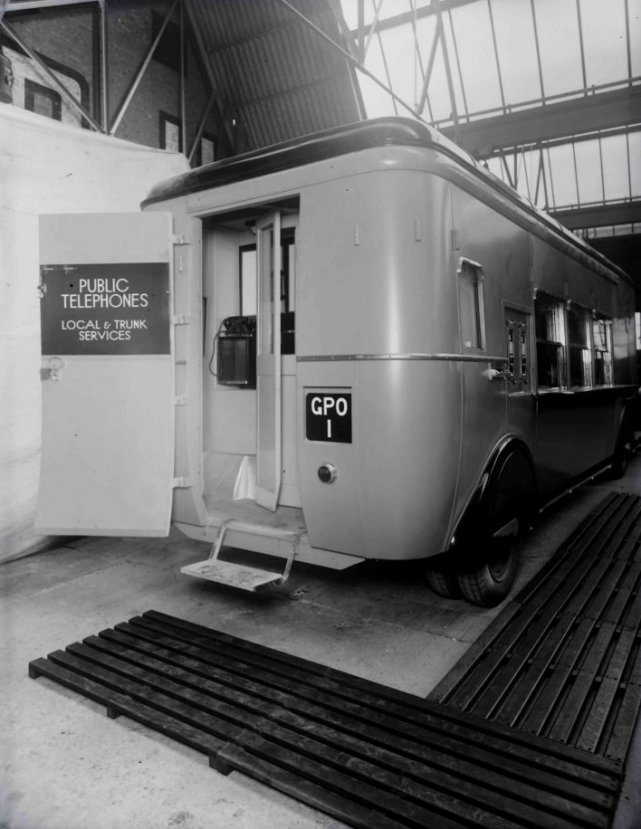
Rear view of trailer
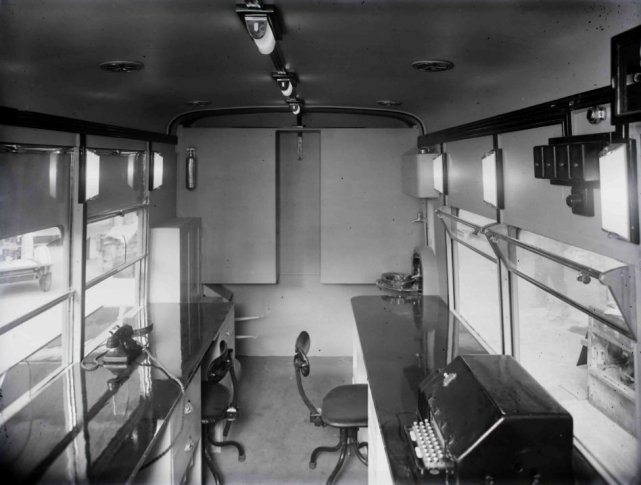
Interior of the trailer looking towards the rear
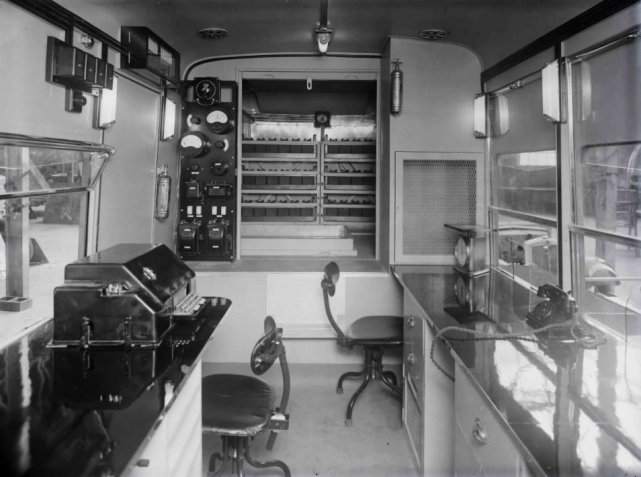
Interior of trailer looking forward
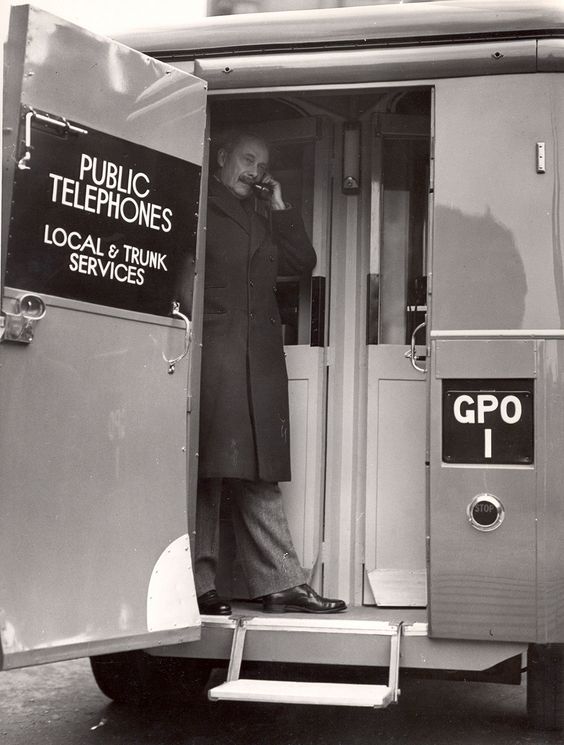
Postmaster General Lord Tryon is using the telephone kiosk in the
Mobile Post Office
Picture dated 1936
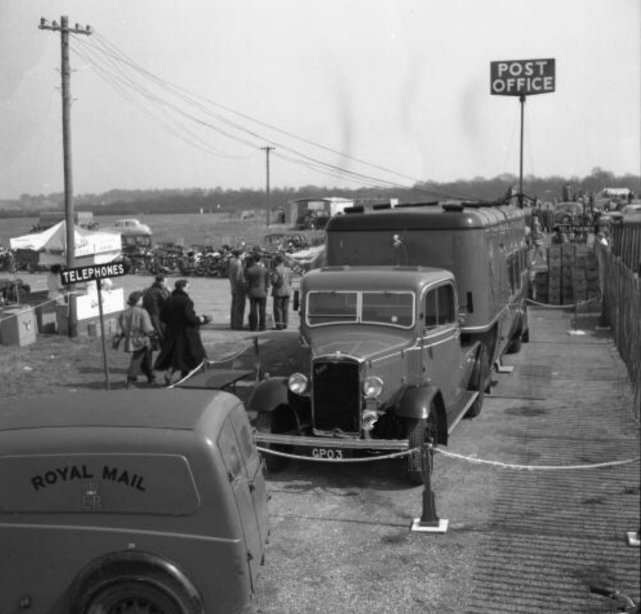
GPO 3
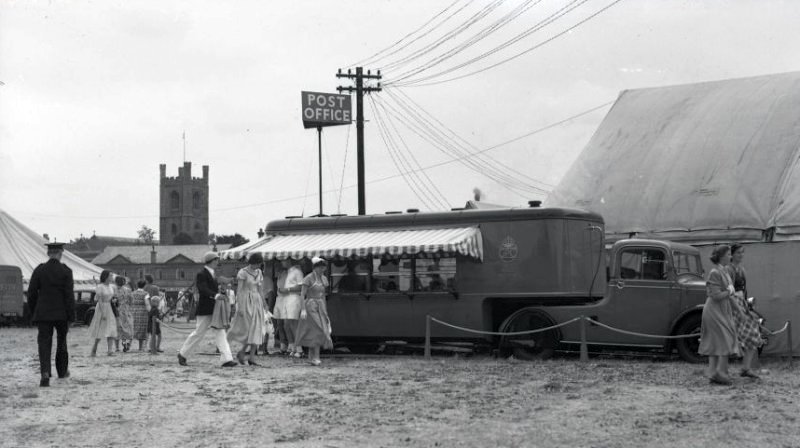
GPO 1 - 1952
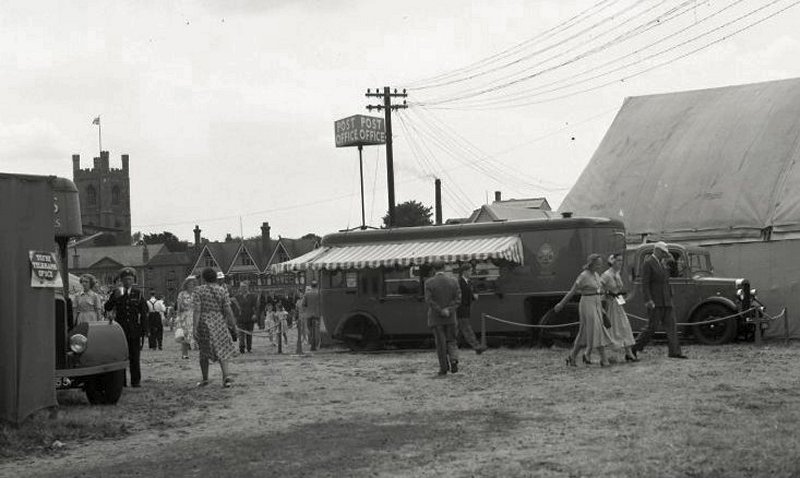
GPO 1 - 1952