| ||||||||||||||||||||||||||||||||
| In 1955 GEC decided to renumber all their telephones with the prefix
TEL. The ST33xx, ST34xx,
ST35xx and ST36xx series,
which were the original catalogue numbers for
this telephone was part of this renumbering. Please see the table below for more
information.
GEC TABLE TELEPHONE A table telephone of modern and distinctive appearance, supplied in either of two models: one for use with automatic exchanges and the other for manually-operated central battery systems. All components, except the dial when fitted, are mounted on a main assembly plate, which can be withdrawn from the case very easily as a complete unit. The G.E.C. Trigger dial, adopted by the British Post Office as their standard, is fitted with a stainless steel finger-plate which retains its high polish indefinitely. The C.B. telephone is the same as the automatic model except that a dial dummy replaces the dial. It can be installed even when a future changeover to automatic switching is anticipated since its conversion to automatic working is a simple operation - the baseplate, main assembly plate and dial dummy are removed, a dial is fixed in position and a dial cord is connected to the internal terminal strip, then the main assembly plate and baseplate are replaced. The cradle-switch mechanism has been specially designed to eliminate any likelihood of sticking plungers. Twin contacts give maximum reliability. The handset is fitted with an inset type transmitter. The flexible handset cord will give exceedingly long service: the conductors are made from tinsel that withstands 200,000 reciprocations without breaking. The four-way plastic terminal strip, connecting the incoming line wires to the telephone cord, has moulded separators between terminal plates to maintain long leakage paths. There are separate entrances for the line wires and the cord. The unfailing efficiency of the G.E.C. Trigger dial mechanism is well known and a special spark quenching circuit protects the impulsing contacts during dialling. If required, a suppression circuit can be included to prevent interference with nearby radio receivers during dialling. A shunt may be connected across the transmitter to minimise the minute arcing that tends to occur at the granules and electrodes as the cradle switch operates ; the accelerated tendency towards frying often shown by transmitters in the tropics is thereby offset. The effect of any increase in transmitter resistance upon line circuit conditions is also minimised by the shunt. The loss in volume efficiency is very small and is partly cancelled by reduction of sidetone, the net result being a difference of only 1db. When required the shunt is connected by the simple transfer of one wire from one terminal to another. Ventilation holes in top and bottom of the case allow air to circulate freely through the case to minimise internal condensation. Metal parts are specially finished, and all wiring is specially made to resist the effects of high humidity and salt-laden atmospheres. All coils are specially treated to render them impervious to damp, heat and sudden changes in temperature. Cradle-switch springs have large insulators to ensure long leakage paths. Flexible cord conductors are V.I.R. covered and braided overall. Since textile bindings are not in contact with conductors, moisture absorption cannot cause leakage. For very dusty atmospheres, a transparent plastic cover can be fitted to the back of the dial to give complete enclosure to the mechanism. Tray dummies are fitted in place of trays on tropical models, thus ensuring that no foreign bodies can enter the instrument. Tropical pattern telephones are normally black, but can be supplied in ivory, jade green or Chinese red with cords and terminal strips finished to match. For ordering please quote the colour required after the Catalogue Number. PART NUMBERS
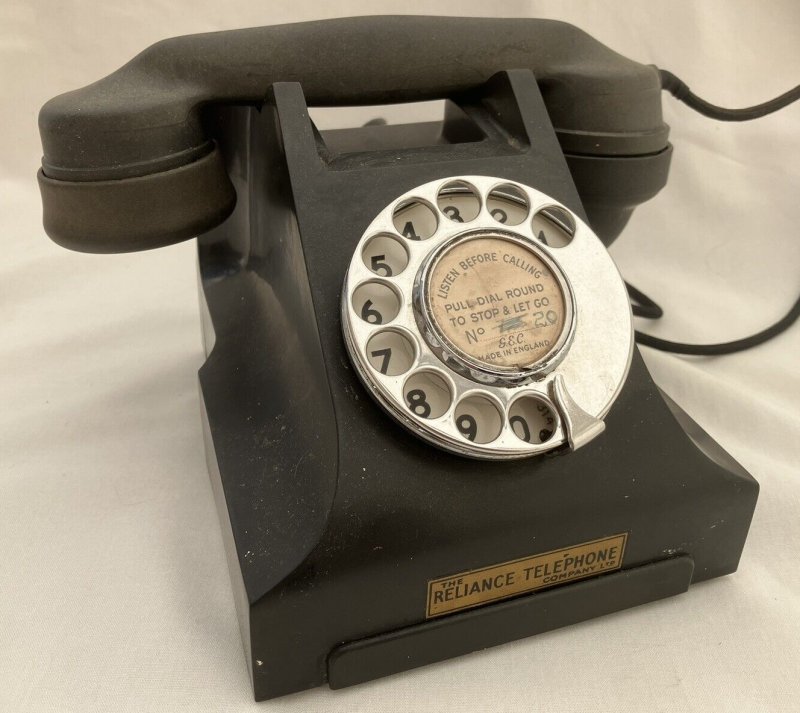
Note : * For use with the 10-line All Relay P.A.X. Cat. No. PX1110 (Standard) and PX1210 (Tropical). Some Tel/1P/ATS were used by the Reliance Telephone Company.
TEL/1P/ATS Circuit Diagram
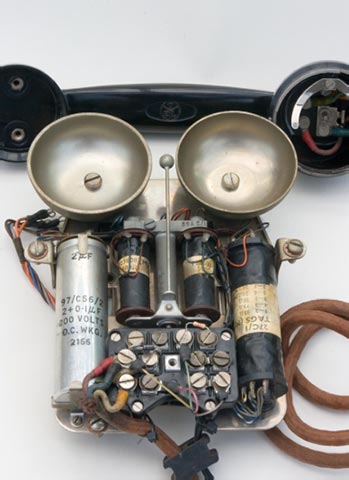
TEL/1P/ATS insides
TEL/1P/ATS
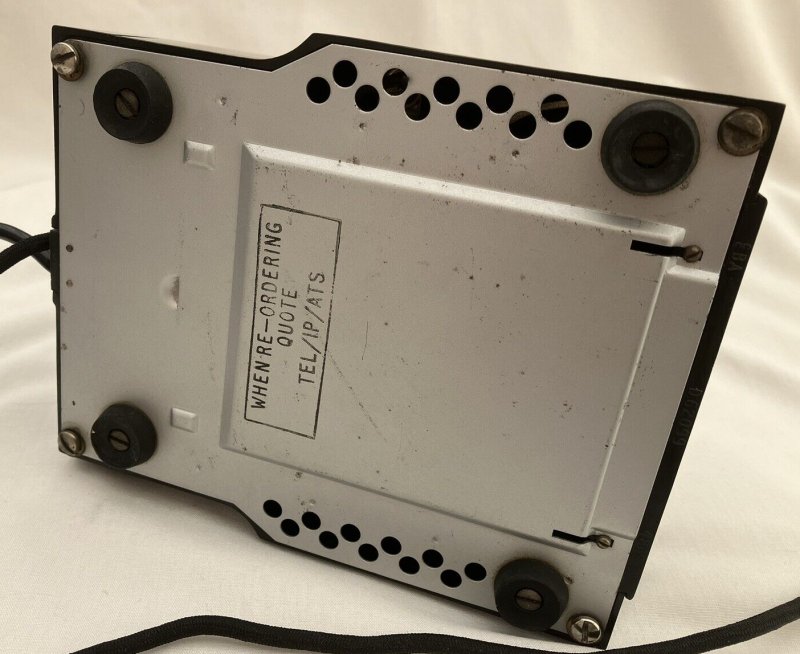
TEL/1P/ATS |
||||||||||||||||||||||||||||||||
Last revised: August 01, 2025FM2 | ||||||||||||||||||||||||||||||||
 GEC
GEC