GEC-AEI TELECOMMUNICATIONS LIMITED
A Management Company of The General Electric Company
Limited of England
10+49 Line Private Automatic Branch Exchange
PB2449

STANDARD FEATURES
Maximum capacity
10 public exchange lines: 49 extension lines.
Connect circuits
Provision for 7 simultaneous inter-extension calls in
addition to a maximum of 10 public exchange calls.
Numbering scheme
21 to 69 for extensions: 7 for tie-line access; 8 for
night service; 9 for public exchange access; 0 for operator/switchboard access.
Public exchange service
Outgoing: direct access from extensions, or through
operator's switchboard. Individual
extensions can be prevented from dialling public-exchange calls.
Incoming: through operator's switchboard.
Enquiry and transfer
Telephones with a pushbutton can be supplied to all or
selected extensions to enable a public-exchange call to be held while the user
calls another extension with an enquiry. When
the enquiry is complete, the original extension returns to the public-exchange
call, or can transfer it to another extension or to the operator.
Night service
Incoming public-exchange calls can be answered from any
extension by dialling '8'; alternatively, the feature can be restricted to one
extension only. Calls can then be
transferred to other extensions by the enquiry and transfer method.
Trunk offer
The operator can offer a public-exchange call to an
extension already engaged.
OPTIONAL
FEATURES
Tie lines
Normally, up to 4 on one route only.
Conference
Designated extensions can be connected together via a
special circuit.
Fire alarm
Various procedures are available to suit individual
requirements and local fire regulations.
Staff location
Staff absent from their offices may be called by
dialling a special locating number and a personal code, to operate lamps or
bells.
Secretary service
A secretarial switching telephone enables secretaries
to filter calls to an executive.
Manual extensions
Up to 4 telephones without dials may be wired direct to
the operator's switchboard for special priority services.
Route restriction
Individual extensions may be permitted to dial local
but not long-distance calls.
Mains fail protection
Public exchange lines can be automatically connected to
designated extensions in the event of an AC mains supply failure.
GENERAL
Mode of operation
Fully automatic operation using 2-motion selectors,
uniselectors and relays. All
conversations secret from each other.
Tones and ringing
All-electronic tone generator provides dial tone, ring
tone and current, busy tone, number unobtainable tone and operator-intrusion
tone.
Signalling
Required dial-pulse characteristics: 7 to 14 i.p.s.,
2:1 break to make ratio.
Alarms
Lamp indication at switchboard.
Urgent: release alarm, ring fail and blown fuse.
Deferred: failure to replace receiver (PG condition).
Power unit
AC power unit: input, 100 to 120V or 200 to 250V 50 to
60 Hz single phase; output 50V d.c. 10A.
or
Battery: 50V 32 AH; with float charger, input as for AC
power unit, output 50V d.c. 3A.
Line-loop resistance
Not to exceed 900 ohms.
Construction
Switching equipment: Plug-in and wired-in units on a
steel framework in a floor-mounting steel cabinet (painted grey) with lift-off
dust-proof panels front and rear.
Switchboard: dual-grey desk-mounting console.
Dimensions and weight
|
Description |
Catalogue Number |
Height |
Width |
Depth |
Weight |
|
Switching equipment
|
PB2449 |
237cm (93in |
109 cm (43 in) |
46
cm (18 in) |
566 kg
(1250 lb) |
|
Switchboard |
|
13cm (5in) |
38
cm (15 in) |
31cm (12 in) |
9 kg
(19 lb) |
|
A C mains unit |
SU3204 |
122cm (48 in) |
48 cm (19
in) |
38cm(15 in) |
108 kg
(238 lb) |
|
Float charger |
SU4202 |
53cm (21in) |
41cm (16in) |
25 cm (10in) |
35 kg
(76 lb) |
Taken from a GEC-AEI brochure SLB7B - dated 1968
This is the Mark 2 variant - see below for more detailed pictures
10+49 LINE PRIVATE AUTOMATIC BRANCH EXCHANGE
- Automatic connexion between extensions.
- Seven connecting links for extension-to-extension calls.
- Dialled access to public exchange by all or selected extensions.
- Compact desk-mounting attendant's cabinet, fitted with key-calling
equipment.
- Access to public exchange via attendant's cabinet by all extensions.
- Incoming calls signalled on attendant's cabinet.
- Trunk-offering facility available at attendant's cabinet.
- Call-back and automatic-transfer facilities on all public exchange calls
available to all or selected extensions.
- Night-service working when attendant is not on duty.
- Dust-proof automatic unit.
The G.E.C. 10 + 49-line private automatic branch exchange has a capacity for
ten lines to a public exchange and forty-nine extensions. One extension calls
another by dialling two digits. An extension obtains direct access to the public
exchange by dialling "9". This direct access is given to selected extensions and
withheld, if desired, from others. All extensions can gain access to the public
exchange via the P.A.B.X. attendant by dialling "0".
An incoming call from the public exchange is signalled on an attendant's
cabinet, and extended to the wanted party by the attendant. Up to seven
extension-to-extension conversations can be held simultaneously. When an
extension makes a call to the public exchange, the connecting link in the
P.A.B.X. is in use only while the connexion to the exchange line is being
established. The link is then released for use by the next caller.
The P.A.B.X. will work to public automatic and C.B. manual exchanges. If the
public exchange is of the Magneto or C.B.S. type, an auxiliary unit is supplied
to effect the necessary signalling.
The automatic exchange unit is housed in a dust-proof, sheet-steel cabinet,
7' 0" x 3' 6" x 1' 10" (214cms x 107cms x 56cms). The cabinet is fitted with
hinged doors, front and rear, to allow easy access to the equipment for
maintenance purposes. The cordless attendant's cabinet is attractively designed
to stand on a desk or table, the size being 10" high, 1' 2" wide and 10" deep
(24cms x 36cms x 25cms).
The complete P.A.B.X. system consists of the automatic unit, attendant's
cabinet, telephones, magneto extension bells when required for night-service
working, line wires from the unit to the telephones, power-supply equipment. and
protection apparatus for all lines that run outside buildings. A distribution
frame on which all lines are terminated, and all protection apparatus mounted,
is recommended for use with this exchange.
STANDARD FEATURES
 FULL
INTERCOM FULL
INTERCOM
Any extension user is connected to any other extension by dialling the
appropriate number. The extensions are normally numbered from 21 to 69.
OUTGOING CALLS
Direct access to the public exchange is obtained by dialling the single
digit "9". If the public exchange is automatic, the caller then dials the number
of the required subscriber ; if the exchange is manual the call is completed by
the public exchange operator. Certain extensions may be barred from this
facility, if desired, by a simple adjustment to the strapping in the automatic
unit.
Alternatively, calls to the public exchange can be made via the
attendant's cabinet, access to which is obtained by dialling the single digit
"0". On dialling "0" an extension is connected to one of the two "0" level
calling lamps on the attendant's cabinet, the lamp flashing to indicate the
call. The attendant answers the call by operating a lever-type key associated
with the calling lamp. The extension may now replace his handset, and is
recalled by the attendant when the call matures. All extensions may obtain calls
to the public exchange via the attendant, and equipment is provided for two
simultaneous "0" level calls. If both the "0" level lines to the attendant's
cabinet are in use, a third party dialling "0" may hold on. He would then be
connected to the attendant automatically when one of the lines became free.
INCOMING CALLS
An incoming call from the public exchange causes an associated lamp on the
attendant's cabinet to flash. The attendant answers the call by operating the
key corresponding to the flashing lamp and extends the caller to the required
extension by key-calling the extension's number on a strip of digit keys of the
plunger type. If the called extension is free, the exchange-line lamp on the
cabinet glows continuously until the call is answered, when the lamp is
extinguished. If the called extension is engaged on an internal call, the
exchange line lamp flashes (at a different frequency to the calling signal) and
the attendant can operate the trunk-offering key and offer the incoming exchange
call.
An extension engaged on a call over an exchange line may hold the call (by
depressing a button on his telephone), while he calls another extension. At the
end of the conversation with the second extension, he resumes his conversation
on the exchange line by depressing the button again. Alternatively, if lie
wishes, he may transfer the exchange line to the other extension merely by
replacing his own handset.
Any telephone may receive a transferred call if it is fitted
with a push-button, the user may transfer the call again.
By pressing the push-button twice in succession an extension can
recall the attendant by causing the associated exchange-line lamp to flash.
MANUAL EXTENSIONS
Four lines are connected direct to the attendant's cabinet. These are
additional to the 49 automatic extensions and are provided for those extensions
who desire the attendant to establish their calls whether internal or external.
The telephones of these extensions are not fitted with a dial, and when the
caller lifts his handset, a lamp flashes on the cabinet. The attendant answers,
establishes the connexion, and then rings back to the caller.
NIGHT SERVICE
Night-service working is established by the operation of the night-service
key on the attendant's cabinet. Two methods of operation may be used, the
required one being selected by the simple adjustment of the strapping on a
terminal block.
In the first scheme, one particular extension is selected to
answer all the incoming calls at night. An incoming call rings this extension's
telephone bell, and to answer the call, the extension lifts the handset and
dials "8".
In the alternative scheme, an incoming call at night rings
separate bells at different selected places. The call is answered at any
extension by lifting the handset and dialling "8". For this arrangement, the
number of bells required should be specified when ordering.
In either system, the call is transferred to a further
extension, if necessary, by means of the call-back and automatic transfer
facility.
AUTOMATIC SERVICE
The automatic-switching apparatus is mounted in a steel cubicle, which has
hinged doors to give access to the equipment. Easily removable metal covers
protect the relays against dust and damage. All the apparatus is the same as
that standardised for large public exchanges in many parts of the world, and
includes the G.E.C. SE50 two-motion selector. Throughout, the unit and apparatus
are designed to give ease of maintenance.
ATTENDANTS CABINET
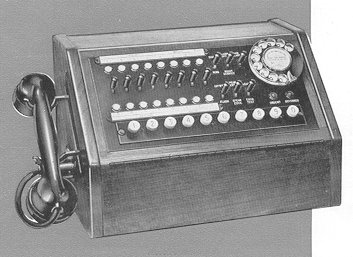 The
compact cabinet, on which the manual equipment is mounted is constructed of
matt-polished hardwood, and the hinged keyshelf and rear wall open up to give
easy access to the wiring and components. The
compact cabinet, on which the manual equipment is mounted is constructed of
matt-polished hardwood, and the hinged keyshelf and rear wall open up to give
easy access to the wiring and components.
Calls to the cabinet are signalled on any of the sixteen calling
lamps of which ten are associated with lines from the public exchange, four with
the P.A.B.X. manual extensions, and two with calls from the automatic
extensions. The call is answered by the simple operation of the key associated
with the flashing lamp.
A strip of plunger-type digit keys provides key-calling
facilities to allow calls to be rapidly connected to the wanted extensions. The
attendant's cabinet is also equipped with a dial for use on calls to the public
exchange, the dial being switched out of circuit when not in use.
Other keys on the cabinet provide for supervisory facilities,
night service, and the extension of alarms from the automatic unit.
POWER SUPPLY
The exchange operates on a 50-volt DC power supply. When the mains supply is
AC, the DC supply may be obtained from a mains unit or from storage batteries. A
G.E.C. mains unit is recommended except where the mains supply is unreliable,
when a storage battery is necessary to maintain continuity of service. When a
battery is employed, a float-charge system should be used.
The recommended capacity for the battery is 30 ampere-hours at
the 10-hour rate of discharge. Further information regarding the mains-supply
units and float chargers is given in G.E.C. Leaflet SUL 1.
When the mains supply is DC, a rheostat should be used to step
the mains voltage down to the voltage required to charge the batteries. With
this arrangement a charge-discharge system must be used so that the battery
connected to the mains is isolated from the exchange.
RINGING AND TONES
Dial, busy, and ringing tones, together with ringing current, are generated
by means of vibrating generators fitted in the automatic unit.
ALARMS
Two alarm lamps are fitted on the attendant's cabinet, one for deferred
alarms and the other for urgent alarms. The deferred-alarm lamp lights to
indicate a P.G. (permanent glow) condition within 30 to 60 seconds of the
condition being set up. The urgent-alarm lamp lights to indicate one of the
following : release alarm, ringing-fail alarm or fuse alarm. An audible alarm
with cut-off key is associated with the alarm lamps.
TELEPHONE INSTRUMENTS
Any automatic telephone having a dial-impulse speed of between 7 and 14
impulses per second, with a ratio of 2 to 1 break to make is suitable for use
with this exchange.
Recommended telephones are the "G.E.C. 1000" Telephone, the Muraphone "K" and
the Gecophone "K" described in G.E.C. Leaflets STL 13 and 14.
A telephone fitted with a push button is supplied for any extension requiring
the call-back and automatic transfer facility. When ordering please state the
number of telephones required with push buttons fitted.
SECRETARY'S SERVICE
A secretary may be provided with a G.E.C. Switching Telephone so that all
calls to an executive may be filtered. The executive would have a G.E.C.
Extension Telephone. Calls between executive and secretary are not routed
through the P.A.B.X.
Full details of this service are given in the G.E.C. Leaflet MTL 2.
LINE WIRES
Insulated twin conductor, suitably protected if exposed to risk of damp
or mechanical damage, may be used to connect the telephones to the exchange
provided the line loop resistance does not exceed 900 ohms. A third wire must be
connected from the telephones of extensions having the call back and automatic
transfer facility to a nearby earth point. If there is no convenient earth
point, the third wire must be run to the exchange unit.
The following table gives examples of maximum lengths for various line-wire
conductors:-
| Size of Copper Conductors |
Maximum Permissible Length of
Cable Pair |
| lb/mile |
AWG (B & S) |
SWG |
mm Diam. |
Yards |
Metres |
| 4 |
26 |
27 |
0.4 |
3560 |
3240 |
| 6.5 |
24 |
25 |
0.408 |
5650 |
5150 |
| 10 |
22 |
23 |
0.64 |
8680 |
7860 |
DISTRIBUTION & PROTECTION
The simplest method of connecting the extension instruments to the P.A.B.X.
unit is to use separate line wires for each telephone. A saving in line wire and
space, with a gain in neatness, may often be achieved by running a multi-core
cable from the P.A.B.X. unit to a distribution box so situated that only short
lengths of wire are required to connect each telephone instrument to the
distribution box.
The exchange equipment must be protected against high voltages
and heavy currents, which may accidentally be introduced into external lines.
Both the lines to the public exchange and all external open-wire extension lines
must be connected to protection apparatus before being extended to the P.A.B.X.
unit. The use of a distribution frame, which mounts all the protection
apparatus, is recommended for this exchange. All the exchange lines and
extension lines terminate on one side of the frame, and cables from the
automatic unit terminate on the other side. The two sides can be cross-connected
as desired. Changes in the allocation of extension numbers. and line testing,
are simplified by the use of a distribution frame.
When a distribution frame is not employed, the G.E.C. protector Cat. No. PR1111,
containing fuses and electrodes is recommended for connexion to the exchange
lines and external extension lines. Protectors for the exchange lines are often
supplied by the public exchange administration.
On receipt of a dimensioned sketch of the premises with
indication of the location of each telephone, the most economical distribution
scheme will be planned, and quotations for materials submitted.
ORDERING INFORMATION
G.E.C. 10+49 LINE P.A.B.X.
| Line Circuits |
Link Circuits |
Dimensions |
Weight |
Catalogue Number |
| Exchange |
Extension |
ins |
cms |
lb |
Kgs |
Standard |
Tropical |
| 10 |
49 |
7 |
84 x 42 x 22 |
214 x 107 x 56 |
1250 |
570 |
PX 2301 |
PX 2401 |
POWER SUPPLY
Power Supply Unit for operation from a 200/250-volt 50c/s single-phase mains
supply, having an output of 48/52 volts DC.
Catalogue Number: SU 1206
Weight: 2381b; 105kgs
Dimensions: 48 x 19 x 14 ins; 122 x 48 x 37cms
Power Supply Unit for operation from any other
single-phase mains supply, having an output of 48/52 volts DC.
Dimensions as above.
Catalogue Number: SU 2206
Automatic Float Battery Charger for operation from a
200/250-volt, 50c/s single-phase mains supply, having an output of 48/52 volts,
0-3 amp DC, and suitable for charging a 24-cell lead-acid battery.
Catalogue Number: SU 1204
Dimensions: 20 x 15 x 9 ins; 53 x 39 x 24cms
Weight: 761b; 34.6kgs
Automatic Float Battery Charger for operation from any
other single-phase mains supply, having an output of 48/52 volts, 0-3 amps DC.
Dimensions as above.
Catalogue Number: SU 2204
24-Cell Lead-Acid Storage Battery less stand, acid and
accessories, capacity 30 ampere-hours at 10-hour rate of discharge.
Catalogue Number: BA 1104
Taken from the GEC Catalogue Leaflet No. PXL 02B (Date unknown) and the GEC Catalogue Leaflet PXL 07 (undated but
probably later than 1959)
An advert for this model can be found in GEC Current Comments, Volume 5,
Number 1, 1950
Current Comments article
Volume 5, No. 2, 1950
10+49 PABX Mark 2 (Drawing 701593)
Additional pictures
Taken in 1962
 |
 |
| Front view with doors fitted |
Rear view with doors removed to expose wiring |
| |
|
 |
 |
| Front view with doors removed |
Front view with doors and some covers removed |
|
 GEC PABX 10+49