|
Magneto Telephones
 |
 |
| N2120H |
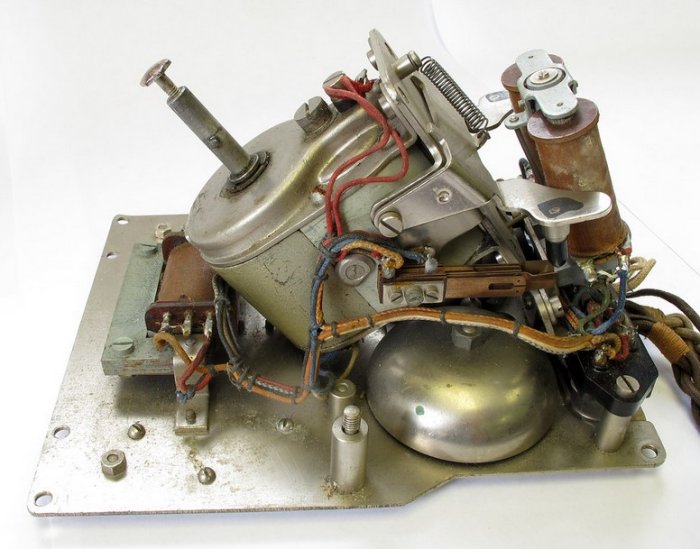
N2120 Internals |
N2120H
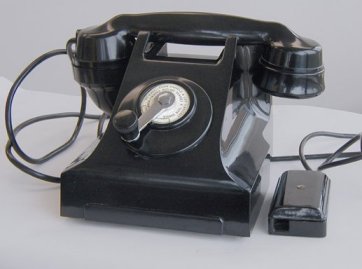
Magneto table telephone with one magnet generator
A one-piece table instrument is at all times preferable to one made up of two or more parts, and the magneto type of telephone has been the most difficult to combine in a neat form.
Hitherto telephones for magneto working have been heavy and cumbersome on account of the size of the generators available. With modern magnetic materials a new and highly efficient magneto generator of very small size and weight has been produced. By incorporating this new generator into our already popular moulded case an instrument of excellent symmetry, light and efficient, is provided for magneto working.
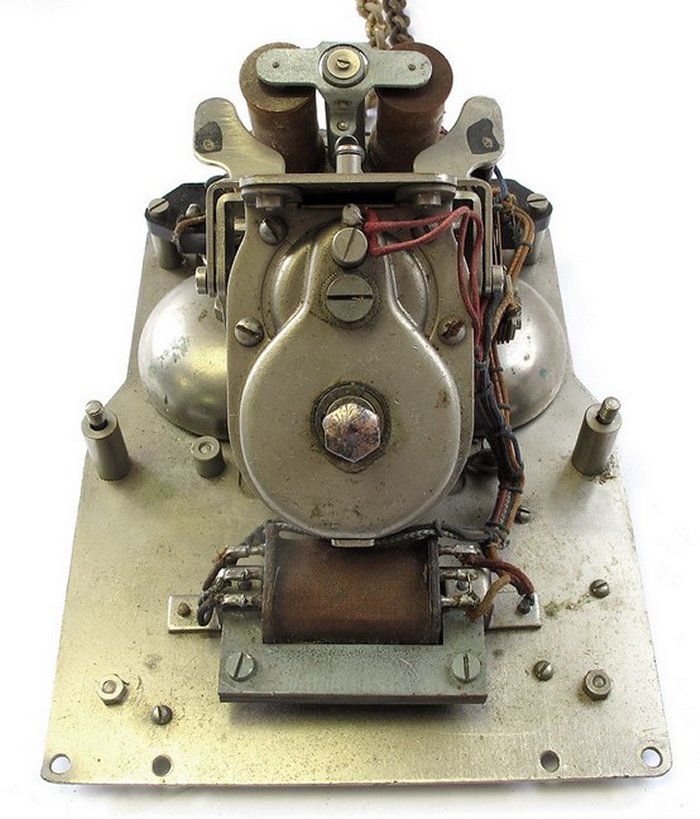
The internal apparatus is mounted on a metal base plate which can be completely detached from the case. The apparatus comprises, induction coil, generator,
1000ohm ringer and gongs, switch springset and cord connecting block, space being also provided for a condenser when required.
The telephone comprises of:-
Micro-telephone N5852, Micro-cord N4021, Inset N7750, Mouthpiece N8634, Receiver
N6815, Earpiece N4443, Receiver Diaphragm N4400, Generator handle N55577 and Terminal Block Cord N4324.
The sliding tray fitment is not practicable on this telephone.
Dimensions - 9.25 x 8 x 6
Weight - 7.5lbs
Note: The ringer handle is offset. It generator has
been moved backwards to allow an extra capacitor fitted to be fitted on the base
plate. This meant that the handle is now not central on the dummy dial
plate.
Additional Information
N2120 - Supplied to the
Irish P&T as their Telephone No. 100M Mark 552.
N2120H - Diagram is dated 1939 and 1948.
N2120H - This model was used by London Transport.
N2120H - May have also been used by GEC -
click here for more information. Used by
the Australian Post Office, their
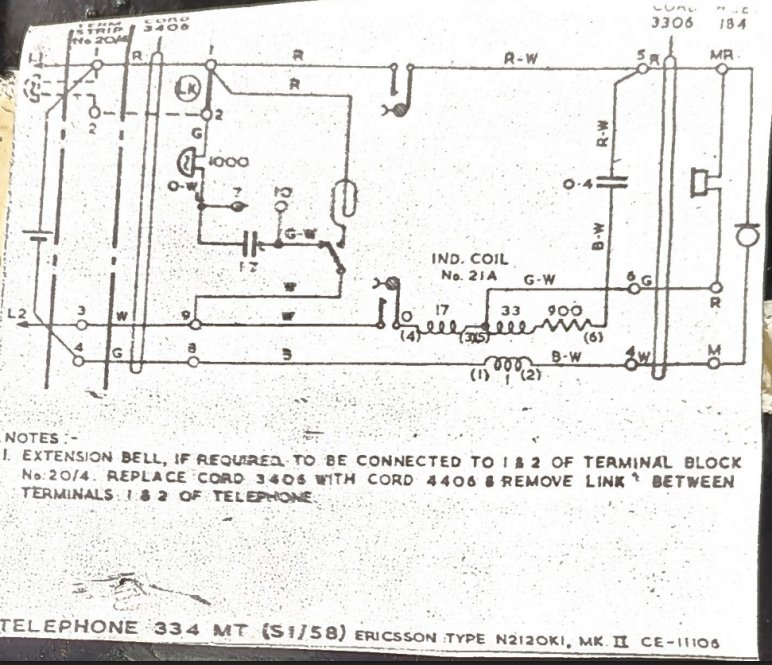
334MT (APO Drawing CE456 sheet 3).
N2120K, N2120K1 and 2120K3 - Specifically made for the Australian Post Office, their
334MT (APO Drawing CE456 sheet 2 and CE1106).
These are some of the differences:-
- 1000ohm ringer.
- A 1.7uF capacitor in series with the ringer, allowing the use on lines
with DC supervision.
- A 0.4uF capacitor as part of the sidetone suppression network
- An additional non inductive 900ohm winding on the induction coil as part
of the sidetone suppression network, making the induction coil a No. 21A instead of
the No. 21 used in the original N2120 versions.
- The electrical arrangements are significantly different with the
intention of improving the sidetone performance compared with earlier circuit
designs. These appear to be a development of the Australian Post Office
Research laboratories.
N2120LT - has an additional 2uf capacitor which can be brought
into use in series with the bell ringer if required (diagram dated 1940).
N2120R1 - Supplied to the New Zealand Post Office.
N2120 is superseded by the N2121.
These telephones require batteries.
Click here for Blueprint of N2120
Click for an article from the
Ericsson Bulletin
Additional information on Australian variants
|
Ericsson No.
|
APO No.
|
Colour
|
Information
|
| N2120H |
334MT |
Black |
GENERATOR THROUGH DIAL DUMMY |
| N2120K |
334MT
|
Black |
GENERATOR THROUGH DIAL DUMMY |
| N2120K1 |
334MT
|
Black |
GENERATOR THROUGH DIAL DUMMY |
| N2120K3 |
334MT
|
Black |
GENERATOR THROUGH DIAL DUMMY |
APO = Australian Post Office
Circuit Diagrams

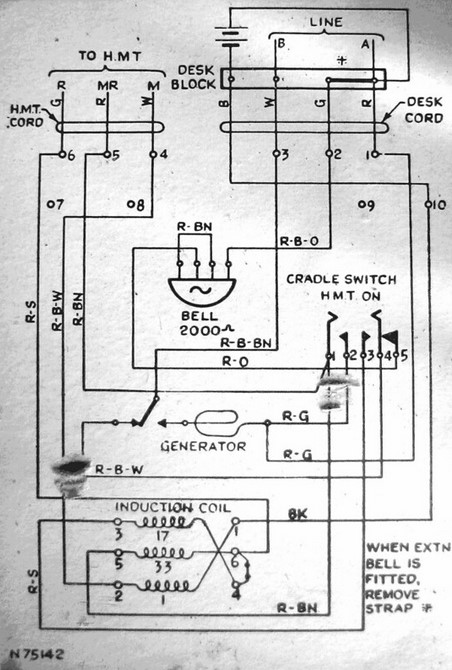
Diagram N57255 issue 3 for Telephones N2120A3, N2120J
& N2120S
Irish P&T
Telephone 100M Mark 552/2
The handset
is P&T 608/184
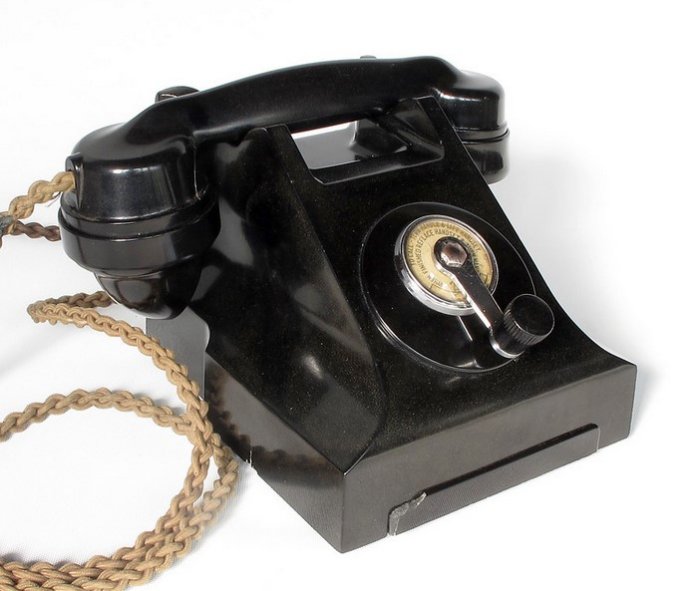
Note that there is no capacitor in this telephone
|
 ERICSSON