Australian Post Office
| |||||||
|
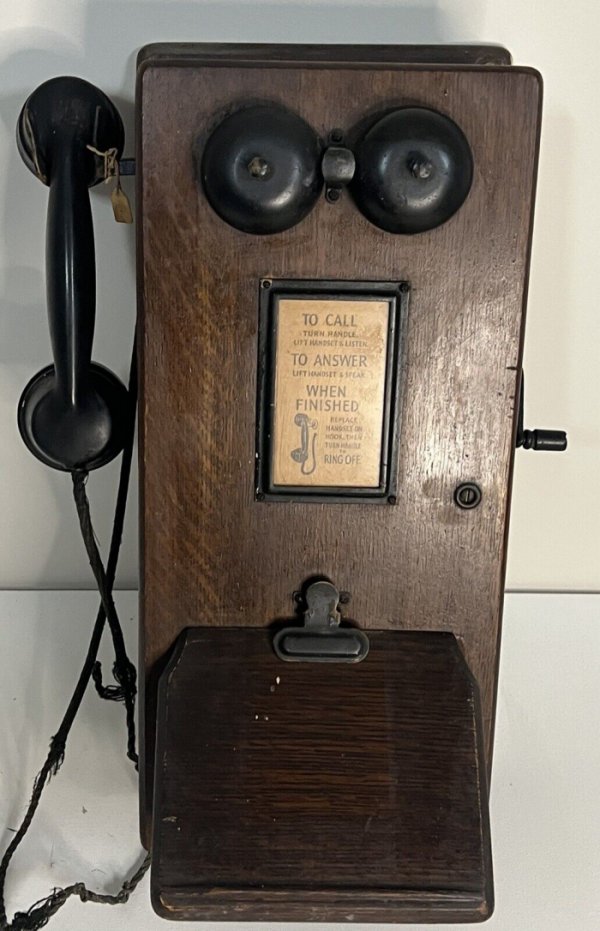
Telephone, Magneto, Wall
These telephones require 3 volts to power the transmitter. Two 1.5 volt batteries would be used which were quite large. As the batteries were fitted inside the telephone, the cases are quite large. The generator is also hefty and produced higher power than the smaller equivalents. These telephones would have been would be used on long distance lines. By 1942 the PMG was running out of magneto telephones. A substantial amount of Australia's phones was still magneto, but supplies from Britain were interrupted by the Second World War. The older Commonwealth Ericsson telephones were wearing out, as were the other early magneto fixed transmitter phones. Many customers were used to the Ericsson handset, and would not like going back to the separate transmitter and receiver arrangement available on other wall phones. The only alternative for a magneto wall phone was to mount a table phone on a wall bracket and mount a separate generator box with it. Commonwealth Ericsson phones, because of their high standard of finish and elaborate woodwork, were expensive to refurbish. A reasonable supply of recovered Stromberg Carlson and Ericsson phones of the Tele 33 and Tele 35 models was available, and these were fairly inexpensive to refurbish. The APO decided to renovate these phones and add a handset to modernise them. A side benefit to the APO was the extra rental charged at that time for handset phones. On 1st June 1942, Engineering Instruction E2020 was released introducing the new phones. Where possible, a Stromberg Carlson was to be replaced with an upgraded Stromberg Carlson, and likewise for the Ericsson models. They were not to be used to replace a Commonwealth Ericsson, however. The Bakelite handset gave better transmission than the old fixed transmitter models, but this was not always the case with an Ericsson handset. The phones were quite suitable for long rural lines. A "How To Call" instruction plate (used to cover the old transmitter holes) was mounted vertically to cover the marks left by the transmitter mount. Writing slopes often had to be replaced, and there are different patterns and timbers used. Each phone was fitted with a note clip at the top of the writing slope. It is possible that similar telephones from Western Electric (later STC) and Kellogg may also have been refurbished under the 233 number. but this is unconfirmed. I have seen a WE telephone so reconditioned , but the circuit diagram was unreadable. This would be the only way to confirm that it was an APO conversion. A similar refurbishment was sometimes carried out in New Zealand, but the old transmitter holes were simply filled with wooden plugs.
Type 233MW Taken from Bob's Old Phones See APO Engineering Instruction E2020. Source: Substation Equipment Handbook 1951. Click here for the Type 235 (Ericsson) Australian Post Office MAGNETO WALL TELEPHONES - HANDSET TYPE 1. The type of magneto handset telephone hitherto used for wall mounting consisted of a Bakelite table telephone and Bellset mounted on a steel wall bracket, together with a separate generator fitted in a wooden case, separately fastened to the wall, and a separate battery box. This combination of standard parts was used in the absence of a satisfactory magneto wall telephone instrument which included a handset. The method of mounting a table telephone on the wall by means of a bracket was therefore the best compromise, but a better method is now available. 2. The advantages of a telephone which Includes & handset have been realised for many years. In magneto service the early Swedish model used in the Commonwealth, and later the Commonwealth Ericsson model, employed a form of handset which gave good service for the requirements or the system at the time, but the type of handset use4, particularly the transmitter, was not suitable for all conditions and was not standardised for modern 8eryice. The Department still has a number of these instruments in service, but has not purchased any of them for years and difficulty occurs in maintenance, because the parts are no longer purchased and replacement parts are dependent upon securing parts obtained from old instruments which have been scrapped. It can be understood, therefore, that when one of those instruments is out of order parts for replacement may not be available. The normal action is to withdraw it from service by replacing it with a later type telephone with fixed transmitter. This is not as convenient ac the handset type, but is the standard on which the Department's present day minimum rental is based It provides satisfactory transmission for normal purposes. 3. Where a wall telephone of the handset type is required, an additional rental is charged and this rental applies to the telephone Instruments 233MW and 235MW described herein. 4. The improvement which a telephone or the handset type affords is in the quality and volume of transmission and reception. These improvements are obtained from the type of transmitter and receiver included in the moulded (Bakelite) handset and by the improved circuit of the telephone. The now instrument gives all those improvements and also is the first magneto handset typo telephone, incorporating anti-sidetone circuit, issued for general use. 5. The improvement afforded by an anti-sidetone circuit is generally known. The anti-sidetone principle reduces the volume or the input speech which is heard in the receiver of, the transmitting telephone. That is, the person speaking will not hoer his own voice so loudly, and external noises in the room will not enter the transmitter and come back into the receiver to the same extent as previously, The speaker therefore hears less "sidetone" in his own receiver when he is speaking and while this adds to his comfort, it causes him to raise his voice slightly And the person at the other end hears him more clearly. 6. The telephones are or tile general types shown in the illustrations on pages 5 and 6, although the notice has been amended slightly. 7. As the telephones are a new issue and will replace the previous standard, this instruction is intended to convey to all concerned, details of the new instrument and the reasons for its adoption as shown in the foregoing. 8. As will be seen from the illustrations, the telephones are of the conventional wall type and are a one piece unit containing all the necessary components. The handset is furnished with what is now a standard type of switch hook and when the telephone is being installed It is desired that the subscriber should he Informed or the need for exercising a little core in hanging up the handset on the switch hook so that the mouthpiece will not strike against the wall. This may happen through carelessness, although the upper portion of the switch hook is set slightly backward so as to reduce the liability to trouble from this source. The attached illustrations have been prepared for use in the country, as it is sometimes necessary for a subscriber to install new dry cells or to change a handset. The illustrations show those two telephones, the layout of components and the circuits. 9. It is also desired that subscribers should be shown the necessity for occasionally clearing the cord from twists and tangling. This action is desirable for all telephones and will tend to reduce the liability to interruption of the subscriber's service through a faulty cord, as well as improving the appearance of the instrument. 10. The advantages are summarised as follow:-
11. Cases have come under notice where it is proposed to issue the new type of instrument as a replacement for the former Swedish or Commonwealth Ericsson type without charging the additional rental. It will, of course, be understood that In no circumstances are these old telephones to be replaced with the new type without the extra rental mentioned. 12. Cases have also come under notice where, for the Swedish or Commonwealth Ericsson type instrument, the old handsets have been replaced by new Bakelite handset and this action is, of course equally wrong, not only because it is an embarrassment to the Department but also because the advantage or the handset cannot be realised under the old circuit conditions. 13. Where Ie1ephones of the new type have been made available by the conversion or renovated wall type wooden telephones, the Installing Mechanic is requested to ace that the telephone 13 not erected unless it is in a condition which is practically equal to new and does not invite criticism In cases where such an instrument may be fitted with a dial dummy it should be returned to Stores. 14. In cases where telephones of the old standard mounted on wall brackets are displayed in situations where they are in the public view, for example, near Post Office Counters, the responsible officer Is requested to examine the possibility of altering the arrangement so that the instrument is converted to a regular table model, or replaced with one of the new type 233MW mentioned herein. 15. Some telephones Type 233MW have diagram fixed inside the instrument which frame of the generator to the break shunt been delivered with a circuit does not show the wire connecting the spring and the L1 terminal of the omission should be noted on your telephone. As opportunity permits, this omission should be notes on records and on diagrams inside telephones. 16. Some of the early deliveries of telephones 233MW (Stromberg Carlson) had the following defects:-
Any telephone containing these defects should be treated as follows:-
17. The paper clip for these instruments is shown on Drawing CE.48 and has
been listed under Item 61 of Serial 15. The clip may be requisitioned to
replace broken ones and supplies are available for repairing telephones in the
Departmental Workshops in each State.
Type 233MW (Stromberg Carlson)
Pictures
233MW
233MW Circuit diagram
|
|||||||
Last revised March 24, 2026 FM2 |
 This type of magneto telephone produced in the PMG workshops from
Stromberg Carlson Telephones
This type of magneto telephone produced in the PMG workshops from
Stromberg Carlson Telephones