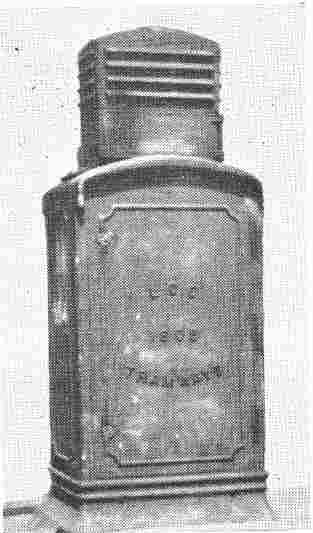
Describing the telephone systems of London Transport is made difficult by the fact that they have evolved and amalgamated over the years, with the present system displaying only the vestiges of a more 'interesting' past. Historically there were three separate but interlinked systems - railway, head office and road control. The first operated as a large PAX system, the second was a PMBX and the last a manual 'traction' or despatcher telephone system. The first two were replaced by a unified automatic system, whilst the road system was replaced by direct exchange lines rented from the Post Office and then by mobile radio. The 'Auto' system (still so called on telephone cabinets) was notable for using letter codes (and retaining them after the public system had abandoned them), meaning that LT auto telephones had lettered dials.
Detailed descriptions of the networks were published in 1950 (Proceedings of the Institution of Railway Signal Engineers) and 1958 (Post Office Telecommunications Journal), making it unnecessary (and unrealistic) to repeat all the information here. The key points and idiosyncrasies are covered naturally.
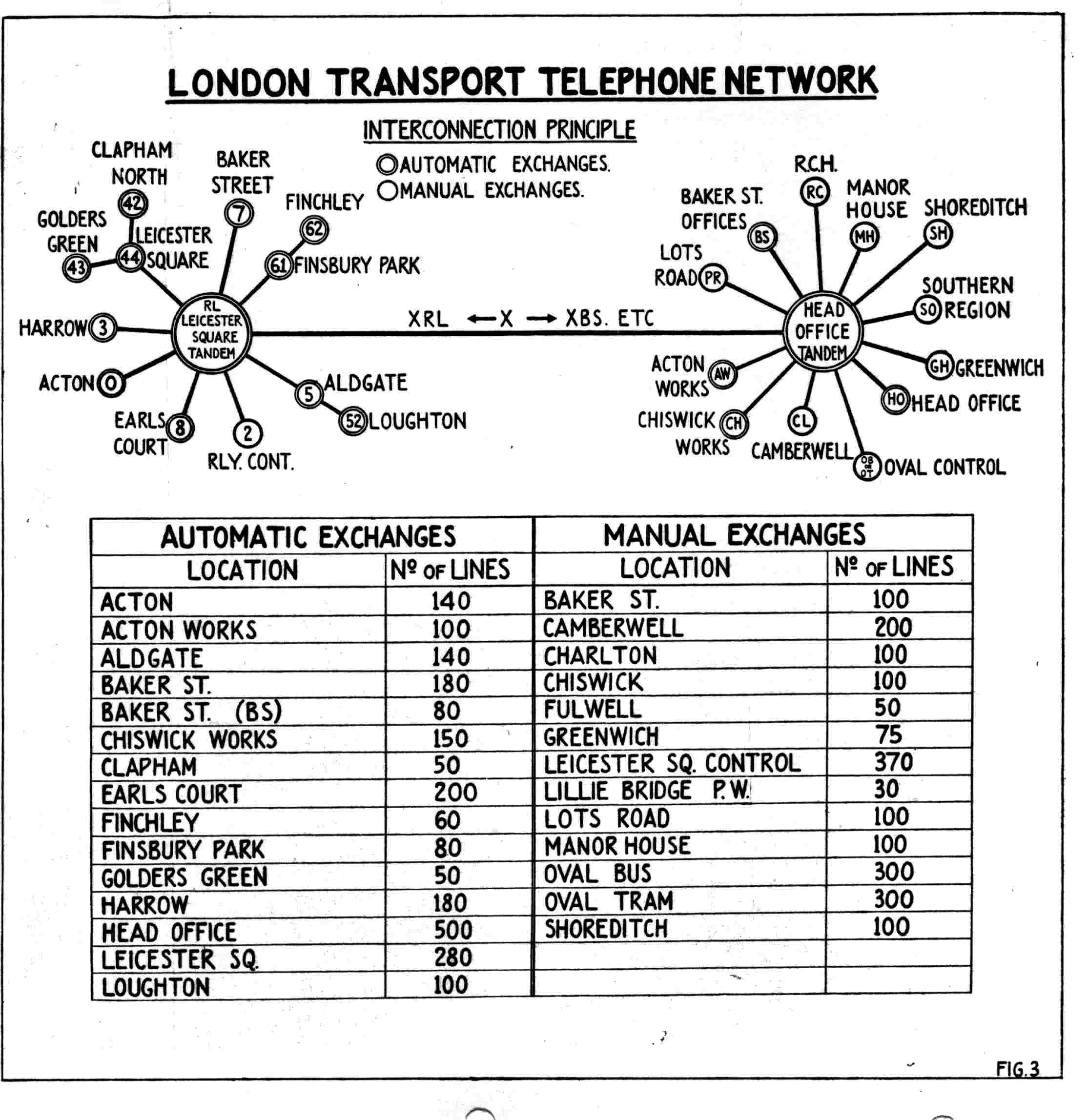
If we examine the network diagram of 1950 the basic principles are clear. The railway auto network is reached by dialling XRL from other auto systems, head office by dialling XHO and there are other three-letter codes starting X for reaching the operator at other exchanges. Locations on the Metropolitan extension line beyond Amersham were reached via Marylebone (BR) exchange on XRL 7162.
Greenwich and Lots Road exchanges were magneto; the other manual exchanges were CB. XPR was the power station at Lots Road. Other alpha codes in use were C for line controller, CE (ditto, in emergency) and INF for information desk. The code 19 reached the breakdown recorder, a tape recording running constantly and giving news of disruption to train services, closed booking offices and so on.
There was no manual board for the auto network, nor was one necessary. The technician's number at each auto exchange ended in 00 (e.g. 8100 at Earls Court); exceptionally Leicester Square was 4400. Line controllers had magneto direct lines to most signal cabins.
In addition to the auto network there were magneto lines ('bridging circuits') between most locations and at virtually every station a telephone kiosk on the platform had a manual switchboard that allowed auto calls to be extended to nearby magneto telephones and also to patch together the magneto lines to the next station in either direction. In this way the network was protected against all kinds of failure.
An entirely separate telephone system was the DRICO (driver to controller) system established in tube train tunnels; two bare lines were run slackly in tunnels at a height that a train driver could easily reach. In the event of a breakdown the driver could press the two wires together, which cut off the traction power, and then attach a telephone with clip leads so that he could talk direct to the line controller.
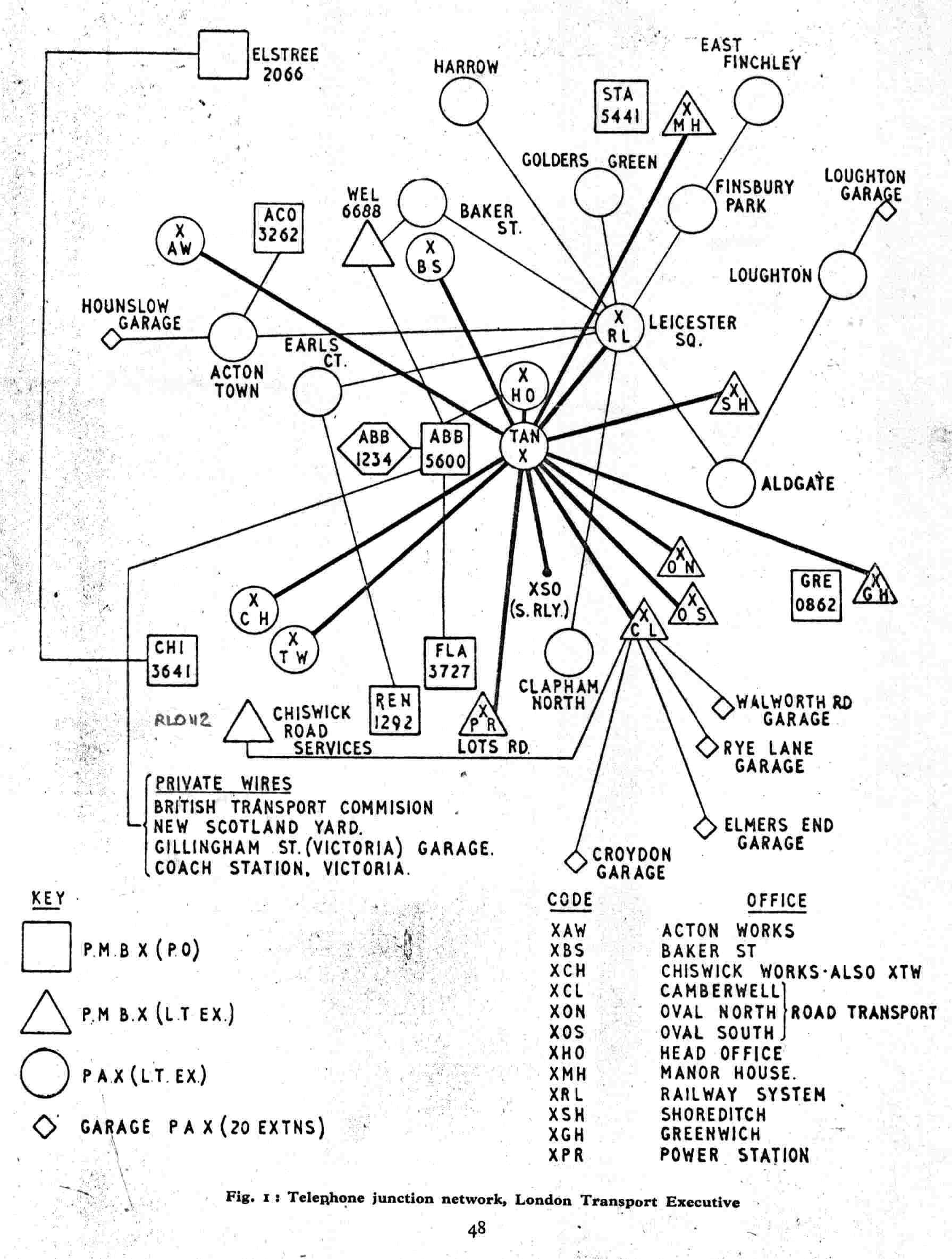
The diagram for 1958 (below) looks slightly different, partly because it now shows the road control network in detail, with a number of bus garage PAX's connected either to the XCL manual board or to railway exchanges. Similar PAX's, to LT's own design, were installed to link electrical substations. To reach these PAX's callers dialled a four-figure number and waited for a ding-dong tone, which indicated they could now dial the remaining digit or digits. This ding-dong sounded exactly like a Morphy-Richards doorbell chime - and that's exactly what it was! The bus refurbishment works at Aldenham and Chiswick are connected by private wire.
At some time soon after this the road control offices at Oval were combined and a new code (XOC) created for Oval Control. XTW stood for Trolleybus Works.
By 1968 the auto system had grown to 13 exchanges and more than 3,000 extensions. The former XHO auto exchange had been incorporated into RL system (old three-digit numbers prefixed 9), whilst the road control telephones (many of whose line wires had been carried on trolleybus poles or in tramways conduits) had been replaced by normal Post Office direct exchange lines (DELs). LT had taken a decision following the abandonment of trams and trolleybuses (and hence the loss of their own wayleaves) that it would be cheaper to install DELs than rent private wires. Reportedly this turned out to be an expensive miscalculation. The numbers for these new telephones were listed in the back of the staff edition of the LT Bus timetables, along with P.O. numbers for garages.
Another miscalculation occurred when a new exchange (possibly an IBM 2750 or 3750) was installed in rented offices at Telstar House, Paddington. Although classified as a PABX, LT trunked it into the auto system (access code 27) without further ado. But then the Post Office refused to connect it to the public network unless they took over all of LT's internal telephone systems. This LT rightly refused as this would increase their costs considerably and P.O. engineers were not safety-trained for working alongside railway tracks. The Post Office held out and forced LT to install a separate PABX, leaving the original intended PABX as a PAX.
Controversy dogged LT again in the early 1980s when it was decided that the Strowger system was life-expired. The £4.8 million replacement contract was awarded to L.M. Ericsson of Sweden, in a deal that was greeted in the press as a deliberate snub to British manufacturers (GEC and Plessey in particular). The new digital system was to link 8,000 telephones, still with no connection to the public network to avoid disputes having BT staff on LT property. It used Ericsson MDS 110 switches (since renamed MD 110), two thirds of the equipment being made in Sweden and a third at the Thorn-Ericsson plant at Scunthorpe.
The new system brought in five-digit numbers, with existing numbers prefixed 3 and the 27xxxx numbers at Telstar House unchanged. Test handover was on 1st April 1984 and actual switchover on 1st September 1984. The old system was to be retained for a while in case of failure (at least two years in the event). The new system comprises two group switching centres at Baker Street and Embankment stations, with local exchanges at those two locations and at 16 others (Balham, Chiswick, Debden, East Finchley, Finsbury Park, Golders Green, Hainault, Head Office, Hounslow West, Mile End, Neasden, Rickmansworth, Ruislip, South Kensington, Telstar House and Upney).
Should the Auto system of today be considered a network of PAXs or PABXs? It's an interesting question and the answer must be the latter, since part of it (extensions with numbers beginning 4) has direct dialling-in access from the public network (on 020-7918).There is no code advertised for outbound dialling into the PSTN, however (there may be 'secret' codes issued to authorised individuals). Provision is made for dialling to and from the national railway telephone extension trunk dialling (ETD) network.